
Charlotte County Court Records After Arrest
A Charlotte County arrest may begin with a warrant, summons, traffic stop, investigation, or other law-enforcement action. If the person is booked into Charlotte County Jail, the custody side is handled by the Sheriff's Office. The court side starts when charges are filed and assigned to the proper court. Those court records after a jail arrest are the better source for hearing dates, charge status, amendments, dispositions, and clerk copies.
Virginia uses Commonwealth's Attorneys rather than district attorneys. In Charlotte County, the Commonwealth's Attorney prosecutes violations of state and local law. Jail booking information can differ from the final court charge because prosecutors may amend, reduce, dismiss, nolle prosequi, or indict charges as the case develops. For custody and booking details, use Charlotte County jail inmate records. For booking photos, use the separate Charlotte County mugshot and FOIA process.
Charlotte County Criminal Courts
Charlotte County's local trial court path is split by case type. The General District Court handles misdemeanors, most traffic offenses, local ordinance criminal cases, and preliminary hearings for felonies. The Circuit Court is the court of record, hears felony cases, and hears appeals from lower courts. Juvenile and Domestic Relations District Court handles juvenile and family matters, but online access is limited because juvenile records are confidential.
| Court or Office | Criminal Record Role | Contact |
|---|---|---|
| General District Court | Misdemeanors, traffic, local ordinance matters, and preliminary felony hearings | 115 David Bruce Avenue, PO Box 127, (434) 542-5600 |
| Circuit Court | Felony cases, appeals, court of record files, and certified copies | 115 David Bruce Avenue, PO Box 38, (434) 542-5147 |
| Juvenile and Domestic Relations Court | Juvenile and family-related criminal matters | Online case details are restricted for confidentiality. |
| Commonwealth's Attorney | Prosecution of state and local criminal law violations | Dan J. Farnsworth, (434) 542-4786 |
Search Court Records After Arrest
Start with the court that matches the case stage. A new misdemeanor, traffic, local ordinance case, or felony preliminary hearing is usually searched first in the Virginia General District Court system. Felony matters may later move to Circuit Court after certification, direct indictment, or appeal. Older records, certified copies, and files that do not appear online may require clerk contact.
- Use the defendant's full legal name and approximate arrest date from the jail or law-enforcement contact.
- Search Virginia General District Court Online Case Information for district-level criminal and traffic cases.
- Use Virginia Judiciary OCIS 2.0 or the circuit clerk for circuit criminal records.
- Read each charge, hearing date, bond entry, warrant entry, and disposition separately.
- Contact the clerk for copies, certified records, older files, or access questions that the online system does not answer.
The Virginia Court Self-Help case search page explains statewide online access and notes that no online case information is available for Juvenile and Domestic Relations Court cases because of confidentiality rules.
The image below is from Virginia's General District Court online case information system, the district-court lookup channel identified in the research file.
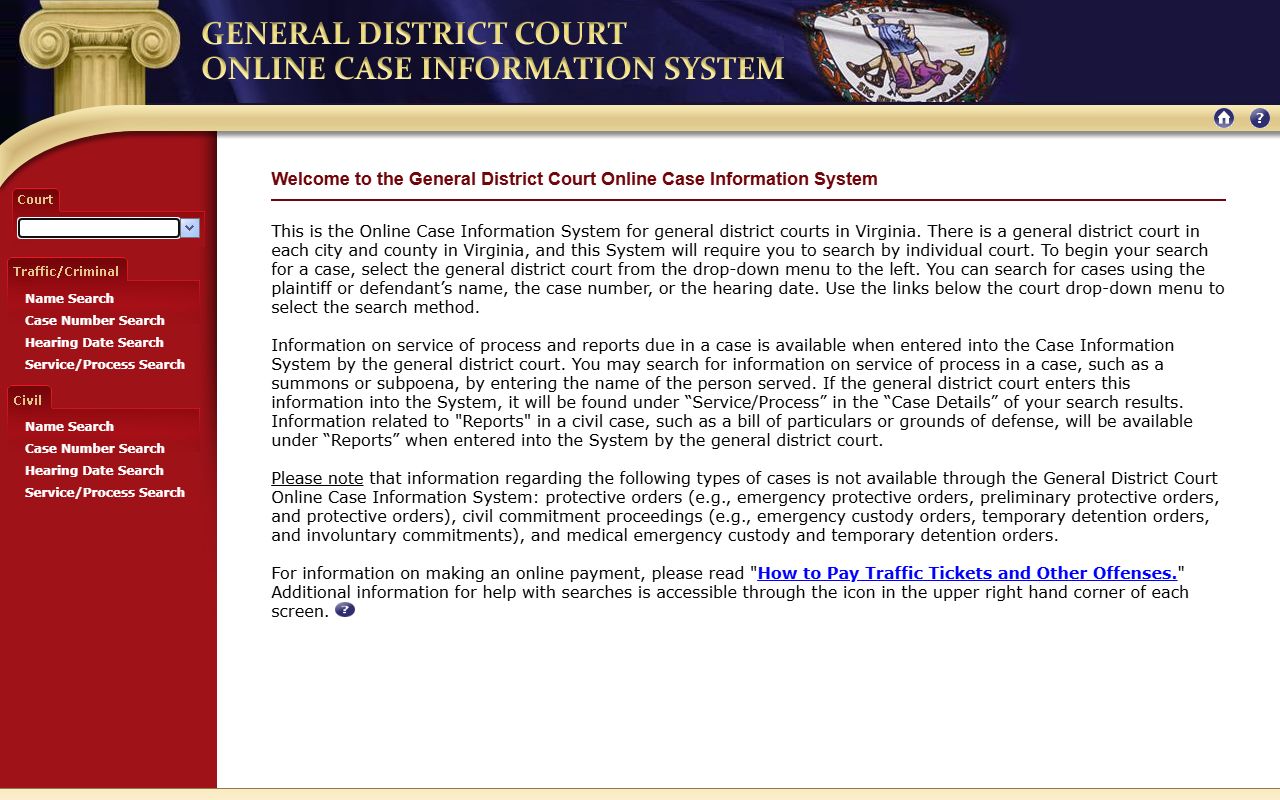
Availability can vary because interactive court pages may show notices or require user navigation, so clerk contact remains important for records that are not visible online.
Charlotte County Case Search Fields
The research file captured partial court-search fields because Virginia's court systems are interactive. Search by name is the common starting point, but a case number, hearing date, or court selection can make the search more precise. Use the court record for the charge list and the jail for physical custody.
| Search Channel | Fields to Use | Best For |
|---|---|---|
| General District Court Online Case Information | Defendant name, case number, hearing date, court selection | Misdemeanors, traffic, ordinance cases, and preliminary felony hearings. |
| OCIS 2.0 | Name or case search after accepting system terms | Circuit and statewide case-search navigation. |
| Circuit Court Clerk | Name, case number, date range, charge, and copy type | Felony files, certified copies, older files, and record room questions. |
| General District Court Clerk | Name, case number, hearing date, and charge | District-level criminal and traffic records. |
Charging Records After Jail Arrest
Charges can enter the court record through different documents. A warrant or complaint may support an early arrest and district-court case. A prosecutor may proceed through information in some contexts. A grand jury indictment moves a felony into Circuit Court. The exact document matters because it shows how the accusation reached court, not whether the person has been convicted.
| Document | Who Uses It | What It Means |
|---|---|---|
| Complaint or warrant | Law enforcement, magistrate, or prosecutor | Starts or supports a criminal accusation after an arrest or investigation. |
| Information | Prosecutor | A prosecutor-filed charge document used in criminal proceedings when allowed. |
| Indictment | Grand jury and Circuit Court | A formal felony charge that can follow preliminary hearing, certification, or direct grand jury action. |
Charlotte County Charge Status
Court records after a Charlotte County jail arrest should be read charge by charge. A single arrest can produce more than one charge, and each charge can have a different status. The booking charge, the charge filed in court, and the final disposition may not match. That does not mean the record is wrong. It often reflects prosecutor review, plea negotiations, indictment, dismissal, or amendment.
| Status | Plain Meaning |
|---|---|
| Pending | The charge is open and has not reached a final outcome. |
| Dismissed | The court dismissed the charge. |
| Nolle prosequi | The prosecutor elected not to proceed at that time. |
| Amended or reduced | The charge changed from the original filing. |
| Convicted or guilty | The court entered a guilty outcome by plea, verdict, or other process. |
| Continued | The matter was moved to another date. |
Bond Records After Arrest
Charlotte County does not publish a local bond-payment instruction page in the official sources reviewed. Call Charlotte County Jail before bringing money or contacting a bondsman. Ask whether bond was set by a magistrate or court, whether the person is bondable, what bond type applies, and whether a probation, parole, federal, immigration, or other-jurisdiction hold prevents release.
| Bond Type or Status | How It Affects a Charlotte County Case |
|---|---|
| Recognizance or PR bond | Release on a promise to appear, often with conditions. |
| Unsecured bond | No upfront cash may be required, but failure to appear can create a financial obligation. |
| Secured or cash bond | Money or security must be posted before release. |
| Surety bond | A licensed bondsman posts surety for a fee. |
| No-bond hold | The person remains held unless a court changes the order. |
| Detainer | Another agency or jurisdiction may block release despite a local bond. |
Warrants Before a Court Record
No official Charlotte County active warrant search form was located in the reviewed official sources. The sheriff site has a Wanted Persons navigation item, but no current searchable warrant database was visible in the indexed page. For warrant questions, use the Sheriff's Office, the General District Court clerk, the Circuit Court clerk, or counsel. Appearing in person on an active warrant can lead to arrest, so call first when safety and legal strategy require it.
- Arrest warrant
- A judicial order authorizing arrest based on a criminal accusation.
- Bench warrant
- A warrant issued by a judge, often after failure to appear.
- Capias
- Virginia court process ordering that a person be taken into custody.
- Search warrant
- A warrant authorizing a search, not always an arrest.
Charges vs Convictions
An arrest or charge is not a conviction. Court records after a jail arrest may show accusations, amendments, dismissed counts, guilty pleas, deferred matters, or convictions. Read the disposition line before drawing conclusions. For employment, housing, credit, insurance, or other regulated screening, use a legally compliant consumer-reporting process rather than a casual web lookup.
| Issue | Charge | Conviction |
|---|---|---|
| Meaning | An accusation filed in court. | A final guilty outcome by plea, finding, or verdict. |
| Stage | Before final judgment. | After court action resolves guilt. |
| Can change? | Yes, it may be amended, reduced, dismissed, or nolle prossed. | Can be appealed or challenged only through legal procedures. |
Sealed and Expunged Arrest Records
Virginia expungement is governed by Virginia Code Section 19.2-392.2 and related provisions. A person seeking expungement normally uses the circuit court where the case was resolved. Dismissal, acquittal, nolle prosequi, mistaken identity, or other eligible outcomes can affect options, but eligibility depends on the exact record and court order.
| Record Access Issue | Sealed | Expunged |
|---|---|---|
| Public visibility | Hidden or limited by court order. | Removed from ordinary public access under the order. |
| Agency access | Some official access may remain. | Access is controlled by Virginia expungement law and the court order. |
| Where to start | Review the case file and order. | Use the circuit court where the case was resolved. |
Restricted Charlotte County Court Records
Not every record tied to a Charlotte County arrest is public online. Juvenile case information is protected. Investigative records may be withheld under Virginia law. Court records may be sealed or expunged by order. Law-enforcement records can contain discretionary exclusions and security-sensitive limits. If an online court search does not show the record, contact the proper clerk or originating agency rather than assuming no case exists.
Important: Court records after arrest can be incomplete online; verify charge status and copies with the proper Charlotte County clerk.